

As we close out 2025, it’s a great time to look back at the trends we’ve seen in evacuation and safety signage requests across businesses, schools, multifamily communities, and other facilities. Clear, effective signage has never been more important, helping guide occupants safely during emergencies.
Here are the top 6 trends in evacuation and safety signage we saw in 2025, and why adopting them is crucial for minimizing liability and maximizing occupant safety in 2026.
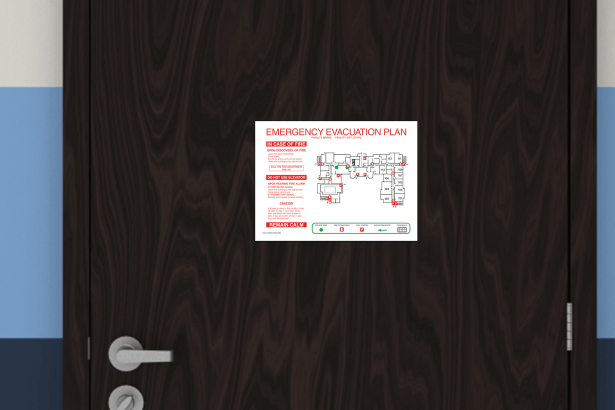
An emergency evacuation plan mounted on a dark wood door, featuring clear fire instructions, exit routes, extinguishers, and stair locations. The map includes bold red and green life-safety symbols and a detailed floor layout, providing a code-aligned evacuation overview for multi-unit facilities.
1. Custom Evacuation Floor Plans and Maps
Today’s facility managers are demanding detailed, custom evacuation floor plans and maps—and for good reason. Generic maps are essentially useless in time-critical emergencies. Evacuation code compliance, like NFPA 101, requires clear, facility-specific plans that show occupants exactly where they are, the primary and secondary escape routes, assembly points, and essential safety equipment locations.
Custom maps remove guesswork and liability. For administrators of healthcare facilities or government buildings, a custom map proves you’ve taken every measure to ensure accurate, compliant egress planning. EvacuationPlans.com specializes in providing Evacuation Map Drawing Services—taking the burden of design and code adherence off your shoulders entirely.
2. ADA-Compliant and Accessible Signage
Accessibility remains legally mandatory. For any facility open to the public, ADA compliant signage is a federal requirement under the Americans with Disabilities Act. Every occupant must be able to navigate a building and find safety, regardless of their visual or mobility status.
Key requirements include tactile text and braille on permanent room identification signs, non-glare finishes, and correct mounting height (48-60 inches on the latch side of doors). When you choose ADA-compliant signs, you align with federal law and significantly reduce the risk of costly compliance lawsuits. EvacuationPlans.com designs signage solutions that meet accessibility guidelines without compromising style.
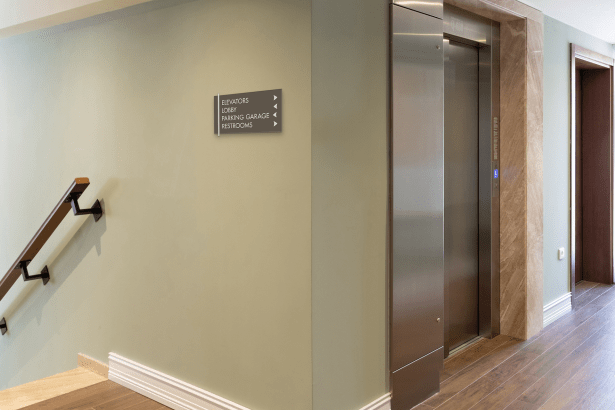
A Midtown 4-Line Directional Sign (MID-D611) mounted near an elevator in a multi-story facility, listing Elevators, Lobby, Parking Garage, and Restrooms with directional arrows. The sign features an Antique Bronze (96) faceplate with Oyster (90) accents, providing clear, code-aligned wayfinding to support safe movement during daily operations and emergency events.
3. Intuitive Wayfinding for Stress-Free Evacuation
During emergencies, people panic. Wayfinding signage uses strategic directional signs to guide people quickly and intuitively, reducing “pre-movement time”—the crucial seconds spent hesitating before moving toward an exit.
Effective wayfinding uses consistent symbols, clear directional arrows, and strategic placement at every decision point. This is crucial in complex environments like hotels and government buildings where visitors are unfamiliar with the layout.
4. Immediate Action Signs: Fire, Safety, and RACE Markers
High-visibility signage for fire extinguishers, AEDs, and RACE fire safety protocol must be visible when smoke or panic clouds judgment. NFPA 10 requires fire extinguishers to be readily accessible and clearly identified, while instructional signs (like RACE: Rescue, Alarm, Confine, Extinguish) must be instantly understandable.
Mounted above 80 inches, overhead directional signage is readable from multiple directions and is especially vital in large, open spaces. Crucially, because this signage is out of reach, it is exempt from the ADA’s tactile text and braille requirements, simplifying compliance.
5. Photoluminescent Signs for Power Failures
When power goes out, photoluminescent signs shine. These glow-in-the-dark signs absorb ambient light during the day and emit a bright glow when the power fails. Research shows that when buildings lose power, the absence of illuminated exit signs can increase evacuation time by 26.6% to 28.1%.
Photoluminescent signs require no wiring or batteries, meet strict safety codes, and ensure that a path to safety remains visible for the critical 90-minute evacuation window. This is a crucial, cost-effective upgrade.

A custom 3D-printed RN95 room number sign featuring raised “328” numerals and braille, displayed on a rounded plaque suspended from a matte black hanging mount. The sign combines a White (02) faceplate with Spanish Leather (17) sides and Black (37) tactile lettering, creating a warm, modern hospitality aesthetic beside a dark wood door and indoor greenery.
6. Dimensional and 3D Signage for High Visibility
Dimensional and 3D signage demands attention in visually busy environments. Featuring raised letters or projecting profiles, these signs create depth and shadow, making them easier to spot from a distance and at oblique angles. They’re ideal for marking exits, stairwells, emergency equipment, and areas of refuge—ensuring occupants find critical information seconds faster.
Looking Ahead: Prioritizing Compliant Safety in 2026
The signage trends we saw in 2025 all point to one clear goal: proactive compliance and crystal-clear communication. This means moving beyond just meeting minimum requirements and investing in solutions that genuinely protect people and property.
Evacuation maps and safety signage will continue to evolve, balancing compliance, clarity, and durability. Expect more custom designs that reflect each facility’s layout, enhanced visual cues for wayfinding, and materials—including photoluminescent options—that ensure visibility and safety in all conditions.
Whether you’re updating your ADA compliant signs, commissioning custom evacuation maps, or switching to photoluminescent signs, EvacuationPlans.com is here to guide you. We specialize in providing code-compliant, reliable, high-visibility safety signage solutions for every facility type across the US and Canada.
See the difference our signage makes. Contact EvacuationPlans.com today to get started on your compliant safety upgrade!
 EvacuationPlans.com