
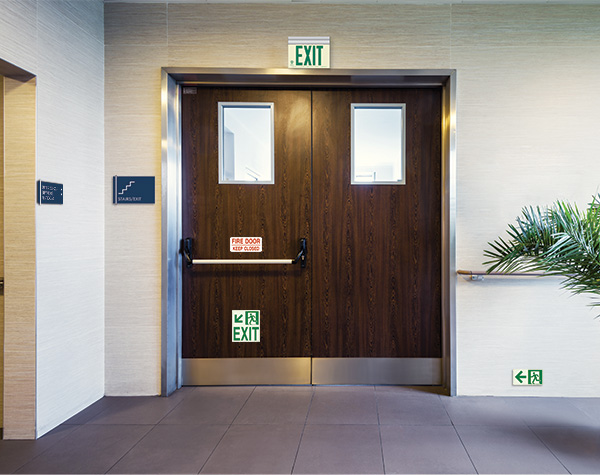
While building owners are more familiar with overhead, externally-powered exit signs, these signs may be difficult to see during an emergency (due to the loss of electricity or a fire). Photoluminescent material offers an alternative. Photoluminescent signs and markings illuminate the exit route without the need for an external power source. In this blog post, we unpack the technicalities surrounding photoluminescent exit materials and offer next steps in helping you figure out the proper egress material you need to prepare your building for an emergency evacuation.
What are luminous egress markers?
To begin, luminous egress path markings are adhesive photoluminescent markers that outline crucial components of and within the egress route—these indicators make it possible to expedite the emergency evacuation process when a building has lost electrical power or smoke has filled the facility. Manufactured by various companies, the markings are built in several different ways, but all markers must conform to a minimum UL standard. These markers are applied to steps, walls, landings, handrails, perimeters, floors, obstacles, door hardware and frames, and are primarily installed within interior locations such as corridors, stairways, and other exit passageways.
Luminous egress markers serve as an additional tool to the low-level luminous egress path exit signage found in section 1013 of the 2018 International Fire Code (IFC), but are made of the same materials. As a distinguishing feature, the self-luminous signage (referenced in IFC section 1013) is designated for exits alone, and not intermediate paths of travel.
Under the IFC, luminous egress path markings are for use in high-rise buildings. A building will be considered a high-rise for the requirements of the code when it exceeds 75 feet in hight from the lowest level of emergency vehicle access. Generally, these buildings are seven stories or higher. That is not to say, however, that photoluminous material cannot be installed in a shorter building—it’s just not required. High-rise buildings present more considerable difficulties evacuating individuals in an emergency, so greater efficiency becomes necessary. Luminous markings and signs allow people to exit a facility more quickly because there are clear indicators of final discharge direction, with an ability to see the exit path in the dark—you can easily see the light at the end of the tunnel.
Are there any caveats or exceptions?
Additionally, we want to note that there are a couple of locations around the country that expressly do not require or have discontinued the requirement for photoluminescent exit path materials. Section 14B-10-1025 of the Chicago Building Code (2019), for example, states that photoluminescent egress path markings are not adopted. The state of Ohio has excluded this requirement from the scope of its building code, but has adopted it within the scope of its fire code. So what do you do when the codes are contradictory? Well, it takes developing a plan with several different organizations sometimes. Using the Ohio example, this particular section of the code, while not mandated under the building code, may very well be a big deal to the fire marshal’s office; therefore, making photoluminescent markings mandatory by default.
EvacuationPlans.com can help!
Due to various jurisdictions around the country, and the rules that may apply, please speak with our team to determine your needs in this area of the building process. We are knowledgable about all building and fire codes within the United States and are able to address your specific needs. Once we narrow your needs, your new egress signage will soon be on its way to your building. Our exit level signage is constructed in Chattanooga, Tennessee, and has been shipped to hundreds of facilities across the U.S. and across the world. Please feel free to browse our photoluminescent signage selection at EvacuationPlans.com, and reach out to our team when you are ready to discuss which signs you need for your building. We are ready to help.
If you need signs for your entire building, our SignSpec© takes the guesswork out of selecting the signs your facility needs. We have taken great lengths to ensure that the type, location, and text of your signs will comply with the ADA, ICC, NFPA, or local code amendments. Just send us a copy of your floor and evacuation plans to get started with a free quote! Again, we are ready to assist any way we can.
 EvacuationPlans.com