
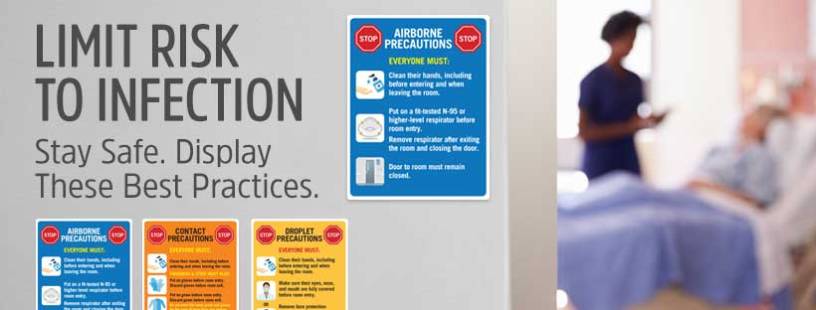
Right now, it’s more important than ever to take precautions to ensure the safety of your patients, visitors, employees, and yourself by limiting the spread of infection, exposure, and germs. Healthcare environments two tiers of recommended precautions, established by the Center for Disease Control (CDC), to prevent the spread of infections. The first involves standard precautions in patient care, and the second refers to transmission-based precautions.
Standard practices apply across the board, no matter what, and prevent the spread of infection between patients. These include washing hands, as well as wearing gloves, gowns, face masks, and even safe injection practices. While these are pretty basic as far as safeguards go, they’re ultimately invaluable for patient care. Healthcare providers have to safely manage current patients, as well as prepare for future patient care with the sanitization of tools, equipment, and other devices associated with medical care. The reason why we take these precautions is to facilitate appropriate decision-making (with anything beyond dependent on the assessed condition).
The CDC has established 3 categories describing the ways in which germs are transmitted: airborne, contact, and droplet safeguards. These categories implement practices above and beyond the usual precautions (i.e., hand washing, gloves, etc.), since for some diseases, these standards alone do not suffice. There can be multiple avenues of transmission, so it’s important to understand which precautions are applicable.
The first primary category involves airborne precautions. According to the CDC, these regulations are implemented for anyone infections involving microorganisms transmitted by airborne droplet nuclei. These infections include measles, tuberculosis, and varicella, and though hand washing is a general best practice, the ability to combat and prevent the spread of these infections requires more than that. Typically, professionals don a N95 face mask, instead of a mere surgical mask. Another common practice includes airborne risk environment signs, which communicate the many important practices to adopt in high-risk patient rooms. These signs require a blue background and include all precautionary rules. You will place these blue airborne precaution signs at doorways.
Contact precautions, the second primary category, require different color coding and safeguards. This category tries to reduce microorganisms that are spread by direct or indirect contact. These infections include Hepatitis A, Shigella, and gastrointestinal issues, and in addition to the basic standards, a gown has to also be worn to prevent exposure. Orange is the color code for these illness, and the orange contact precuation signage will list necessary Personal Protective Equipment (PPE) to be worn.
Droplet precautions are the last primary classification, and it’s in between the previous two category since it involves infections that are not airborne or from direct external contact. These pathogens are spread through close respiratory or mucous membrane contact with respiratory secretions, and droplet infections occur through large particles from a person’s coughing, sneezing, and talking. Contagions in this category include Influenza, Meningitis, and Mumps, and standard precautions and other PPE measures apply. When individuals are isolated, yellow is is the color code for infections passed by droplets; therefore, droplet precaution signs are in yellow.
It’s vitally important to follow all of these standard, airborne, contact, and droplet precautions. Practicing this will prevent the transmission of germs and pathogens at your facility while protecting vulnerable patients. Likewise, by displaying the appropriate airborne, contact, or droplet precaution signage outside patient rooms, everyone entering will know which important protocols to follow.
Here at EvacuationPlans.com, we are more than eager to assist you in addressing your precaution and infection control signage needs. Our signage adheres to both ADA and CDC guidelines, and each sign is digitally printed, features velcro coins for easy installation, and is suitable for interior use within your healthcare facility. They’re also covered by our unparalleled guarantees, including Life of the Building and ADA Compliance. Have any questions? Contact us at 877.714.6588 or emailus@evacuationplans.com, and trust our sign experts at EvacuationPlans.com to help equip your healthcare facility today! It is important to remind everyone about best practices for airborne, contact, and droplet precautions, so order your precaution signs!
We also wanted to take a moment to thank all healthcare industry employees for your dedication, sacrifice, and commitment to your patients and residents during this unprecedented time. We are truly grateful for all that you are doing to protect the medically vulnerable.
 EvacuationPlans.com